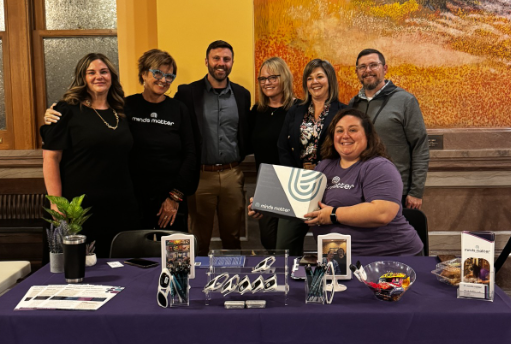
For National Rehabilitation Month, we’re celebrating the people and purpose behind community-based therapy at Minds Matter, LLC. Rehabilitation can make a meaningful difference when it happens in the places people live, work, and connect with others. Let’s see what Angi Hill, Director of Physical Therapy, Dawn Prehn, Director of Occupational Therapy, and Lauren Jennings, SLP Documentation and Quality Assurance Lead had to share on why this work matters to them.
Angi Hill, RPT, CBIS, CCI, AIB-VRC
As a Therapist, Imagine a Place Where…
- Therapy is truly consumer-driven and person-centered. Consumers are involved in conversations and decisions about their services. They are treated with the same respect, dignity, and consideration that we would all want if we were in their shoes.
- Treatment focuses on what matters most to the consumer. Therapy is centered around the goals they want to achieve and the things that will help them become more independent and engaged in their homes, communities, and everyday lives. Sessions take place in the consumer’s natural environments, where therapy can have the greatest real-world impact.
- Therapy is fun, creative, and functional. Instead of simply working on exercises in a clinic, you get to work on meaningful, real-world activities in the home and community. If a consumer wants to get back to fishing, you can work on the skills needed to make that possible. If they want to develop an exercise routine they can participate in at a community center, you can help them build that routine. If they need to improve their balance and walking in busy environments, you can practice those skills at the grocery store or other places in the community. When your clinical expertise is needed, you can even support consumers during medical appointments or while navigating transportation and other community activities.
- Sessions are long enough to make therapy meaningful. Consumer sessions are typically 1.5–2 hours, allowing time for sessions to flow naturally without feeling rushed. There is time for rest breaks when needed, practicing and progressing daily activities, problem-solving, addressing equipment needs, researching solutions, advocating for the consumer’s needs, and getting out into the community.
- Consumers have a collaborative team. Consumers have a team of therapists working with them, along with periodic team meetings to discuss progress, share ideas, and determine the next steps based on what the consumer wants to accomplish.
- You receive a thorough orientation. New therapists participate in an extensive orientation that lasts several days, including multiple opportunities for observation to help you understand the role and feel prepared to begin.
- You receive mentorship when you need it most. During your first few months, you have access to mentorship and support as you learn your new role and become comfortable with the position.
- Communication and support are readily available. There are multiple layers of communication throughout the workday, questions are answered promptly, and assistance provided for problem solving when needed.
- PTA supervision is truly a team effort. Supervision is approached as teamwork, as it should be. PTs and PTAs are encouraged to collaborate and work together with the consumer during reevaluations and supervision visits.
- Documentation doesn’t take you away from your consumer. You aren’t left scrambling to complete documentation after a full day of therapy. Documentation is completed during the session on a tablet provided by the company, allowing you to stay focused on the consumer and their goals.
- Your education and professional growth are valued. The company provides continuing education, meetings, and training opportunities designed to expand your knowledge and strengthen your therapy skills.
- Work-life balance matters. There is an emphasis on maintaining a healthy balance between your professional responsibilities and your life outside of work.
- Consumers and staff are genuinely cared for and valued. Every day, the focus is on creating an environment where both the people receiving services and the people providing them feel respected, supported, and appreciated.
This Company Is Real.
This company is Minds Matter LLC.
These are the reasons I chose to work for Minds Matter—and why, 13 years later, I am still here.
It is truly the best job I have ever had.
I am incredibly grateful to work for a company that believes therapy should be meaningful, individualized, collaborative, and focused on what matters most: helping consumers live the lives they want to live while supporting the therapists who make that possible.
Dawn Prehn, OTR/L, CBIS
Occupational therapy professionals help people recovering from brain injury relearn daily tasks and routines, such as showering, dressing, cooking, and completing household chores. Minds Matter therapists are privileged to support consumers in their homes as they rebuild these essential skills, but therapy does not stop at the front door.
Minds Matter therapists stand out for what they do best: delivering creative, person-centered therapy in the community. National Rehabilitation Awareness Month is a great opportunity to recognize the meaningful work our therapists and consumers do together beyond the walls of the home.
What does community-based therapy look like? It centers on what matters most to each consumer. Consumers lead the way by identifying what they want and need to do, while therapists problem-solve alongside them to help meet their goals. One consumer is preparing to walk down the aisle at her daughter’s beach wedding by practicing walking with her therapist at a local sand volleyball court. Another worked with his therapist to find a nearby gaming store and practice safely navigating wheelchair-accessibility challenges along the route. He now visits independently and regularly joins group game sessions with friends he has made there.
Other examples of consumer-led community therapy include helping a young consumer shop for snacks at a local store, teaching a consumer with visual impairments to navigate her neighborhood so she can walk her dog, and visiting a rock-climbing gym to explore adaptive sports options.
Community-based sessions often help consumers build several skills at once. During a restaurant outing, for example, a consumer may practice navigating the space, reading and ordering from the menu, interacting with staff and other patrons, eating and drinking, and paying the bill.
Minds Matter therapists truly have the best job in the world. Working with consumers in the community means no two days are the same, and few things are more rewarding than seeing a consumer’s confidence and independence grow as they practice everyday skills in their own neighborhoods, build friendships, and return to living, working, volunteering, and playing on their own terms.
This National Rehabilitation Awareness Month, we extend a heartfelt THANK YOU to our therapists for providing creative, person-centered, and meaningful therapy in the community.
Lauren Jennings, CCC-SLP
More Than Speech Therapy: Being an SLP at Minds Matter
As a speech-language pathologist, I have always loved that our profession allows us to help people reconnect with the things that make life meaningful. At Minds Matter, I get to take that a step further. Instead of working on skills in a clinic and hoping they carry over into everyday life, I get to meet people where they actually live, work, and spend their time.
Community-based rehabilitation has completely changed the way I think about therapy. A successful session might mean helping someone organize their home, develop strategies to plan a fun outing, communicate more effectively with their grandkids, or build the confidence to participate in a conversation with a neighbor. Sometimes the biggest victories aren’t dramatic—they’re the small moments when a person realizes, “I can do this.”
Working with consumers with brain injuries has also taught me that communication and cognition are deeply connected to independence and identity. As SLPs, we have the opportunity to help people navigate the real-world challenges that can follow an injury, while focusing on the goals that matter most to them. We aren’t simply treating a diagnosis; we’re helping someone get back to being themselves.
That’s one of the things that drew me to Minds Matter. I appreciate that the focus is on the whole person and that rehabilitation doesn’t stop at the front door of a clinic. We work alongside other disciplines, families, caregivers, and the consumers themselves to find practical strategies that actually fit into their lives.
For therapists considering Minds Matter, I think one of the most rewarding parts of the job is the opportunity to be creative. Every person, home, and situation is different. You have to think beyond worksheets and traditional therapy activities and ask, “What does this person actually need to be successful and happy in their life?”
And then you get to celebrate those small wins with them.
Those wins are why I love being an SLP. They are also why I love doing this work at Minds Matter.